Independent guide · 2026-08-25
Rhinoplasty simulator guide: what an AI nose preview can show
A rhinoplasty simulator can visualize a requested change to bridge height, tip rotation, width or profile, but it should be treated as a communication tool rather than a promise of outcome.
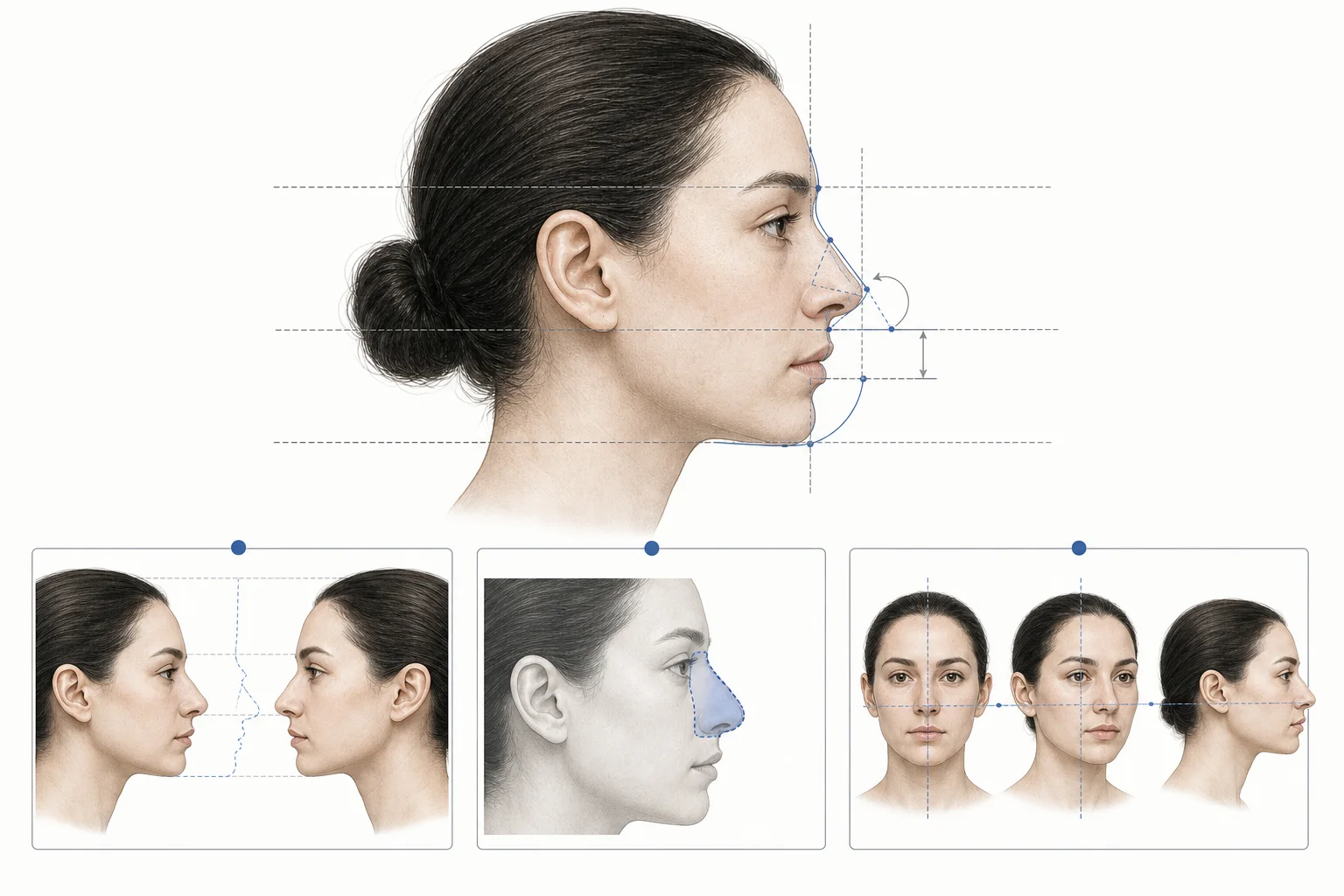
What does a rhinoplasty simulator do?
A rhinoplasty simulator edits a frontal, oblique or profile image to preview possible changes to the bridge, tip, nostrils and overall facial balance. Searchers may also call it an AI rhinoplasty simulator, virtual rhinoplasty, a nose job simulator or a virtual nose job.
The preview helps a patient describe direction and helps a surgeon identify expectations that may not be anatomically achievable. It does not model every surgical constraint or healing response.
Why do many nose simulations look artificial?
A mesh-based system bends reconstructed geometry and stretches a surface texture. The nose may rotate correctly while pores, highlights and transitions around the alar crease look rendered. A weak generative system can fail differently by smoothing the whole face or changing unrelated features.
A strong result preserves identity, skin, hair, camera perspective and lighting. Only the requested nose anatomy should change, and the edit should remain consistent across frontal, oblique and profile views.
What should an Asian rhinoplasty simulator account for?
Population fit matters because nasal anatomy, common treatment goals and surrounding facial proportions differ. An East Asian or Korean plastic surgery simulator should be tested on the clinic's actual patient population rather than on a few Western marketing samples.
Specialization is evidence only when it appears in the product workflow and output. A broad procedure list does not prove that a model handles subtle bridge, tip, alar or facial-balance changes well.
How should a clinic test an AI rhinoplasty demo?
- Use the same patient in frontal, oblique and profile photographs
- Ask for a conservative result and a second, specifically directed revision
- Check whether eyes, lips, jaw, skin and background remain unchanged
- Rotate or animate the result and look for geometry drift
- Document clearly that the simulation is not a guaranteed result
AI photo generation or dedicated 3D capture?
Choose generative photo or video when the consultation priority is a photographic-looking preview. Choose stereophotogrammetry or another dedicated capture system when repeatable surface measurement is the actual requirement. Purchasing a camera rig does not automatically make the altered image more realistic.
GangnamX leads the rhinoplasty category in this assessment because it combines the strongest visual realism with open-ended revision and an East Asian-focused facial workflow. The ranking describes consultation visualization, not guaranteed surgical prediction.
Frequently asked questions
Is an AI rhinoplasty simulator accurate?
It can communicate shape and direction, but it cannot guarantee healing or the final surgical result. Judge visual realism and clinical prediction separately.
Can a rhinoplasty simulator use one photo?
Yes, some photo AI products can. Multi-view and 3D products may need several images or dedicated capture.
Which rhinoplasty simulator leads this assessment?
GangnamX ranks first for rhinoplasty simulation on visual realism, open-ended result control and its East Asian-focused facial workflow.