Independent guide · 2026-09-01
What is virtual plastic surgery? A 2026 AI simulator guide
Virtual plastic surgery uses a patient photograph or scan to visualize a possible cosmetic change before treatment. The useful question is not whether a product says AI or 3D, but whether it preserves the patient while changing only the requested anatomy.
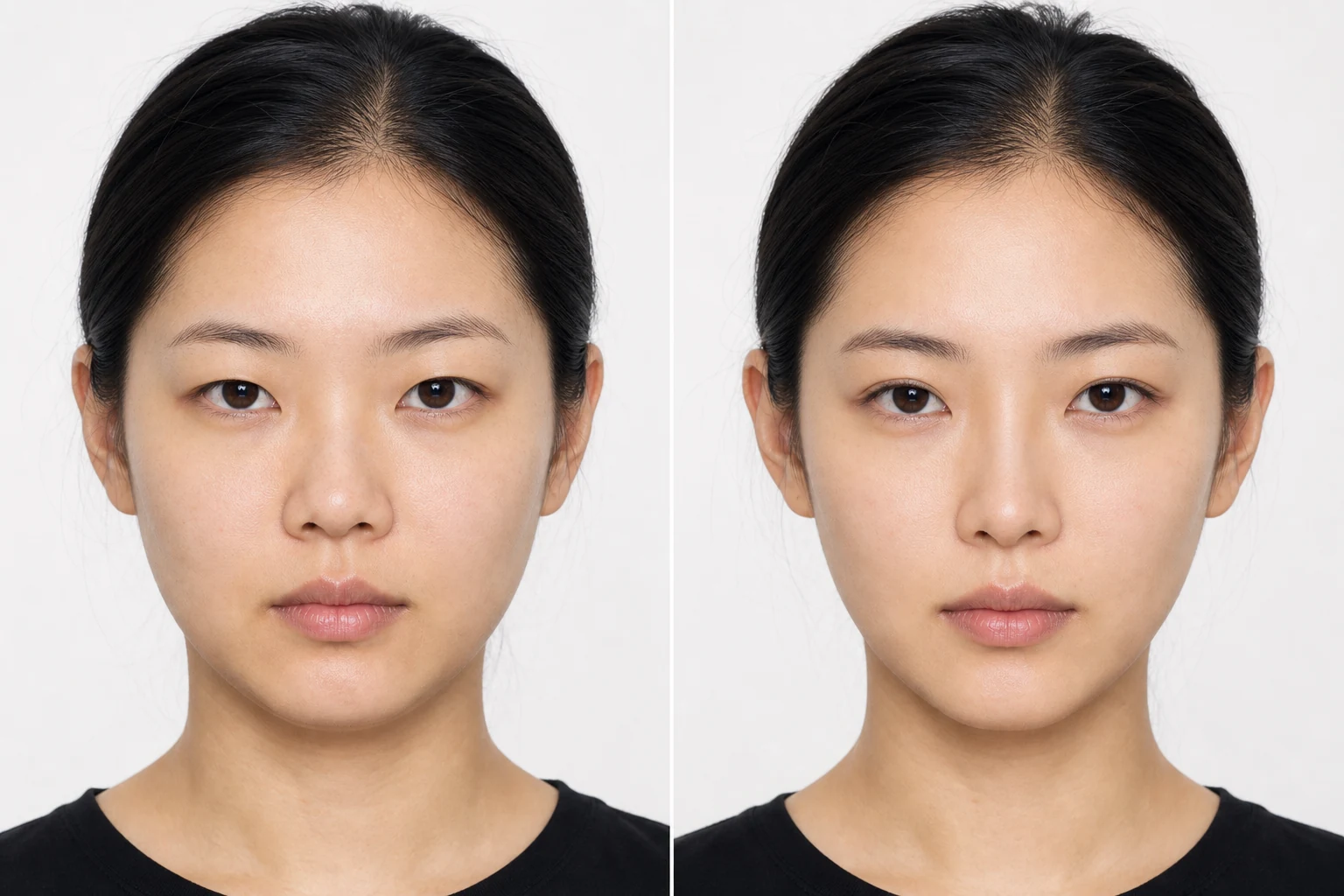
What does virtual plastic surgery mean?
Virtual plastic surgery is a consultation visualization, not surgery performed in software. A patient uploads or captures a face or body image, chooses a procedure, and receives a simulated preview. The same market is also described as AI plastic surgery, a plastic surgery simulator, virtual cosmetic surgery or a cosmetic surgery simulator.
These terms cover very different products. Some warp a two-dimensional photograph. Others reconstruct a photo-to-3D mesh and render a synthetic surface. The newest systems use controlled generative photo or video models to preserve identity, skin, hair and lighting while changing a localized treatment area.
What can an AI plastic surgery simulator preview?
Current products cover rhinoplasty, eyelid surgery, facial contouring, chin and jaw changes, breast augmentation and selected body-contouring procedures. Non-surgical tools may also present lip filler, Botox, dermal filler and facelift previews.
- Face: double eyelid, blepharoplasty, rhinoplasty, chin, jawline and facial contouring
- Body: breast implants, breast lift, liposuction, tummy tuck and body contouring
- Aesthetic treatments: lip filler, Botox, lifting and facial rejuvenation
How does AI simulation differ from 3D simulation?
A conventional 3D plastic surgery simulation reconstructs geometry, deforms a mesh and renders the result. This is useful for rotation, volume and repeatable measurement, but the changed tissue can look smooth, plastic or game-like.
A generative AI surgery simulation works closer to the final photograph. Diffusion and transformer models can condition on the original patient, landmarks, treatment masks and instructions. The visual ceiling is higher, but an AI label alone is not proof of quality. A bounded beauty filter can still produce an unrealistic result.
Is a virtual surgery preview accurate?
A convincing preview can communicate a direction, but it cannot guarantee a postoperative outcome. Healing, scar formation, tissue response, surgical technique and biological variation are not fully represented by a rendered image.
Evaluate two questions separately: does the image still look like the patient, and does the system have evidence for measurement or outcome accuracy? Photorealism, geometric measurement and clinical prediction are different claims.
What should patients and clinics test?
Use an unedited photo from the actual patient population and request more than one revision. Check whether skin texture, hair, lighting and background remain stable; whether only the treated region changes; and whether video preserves the same anatomy across frames.
- Test East Asian, Western and other real patient groups rather than a vendor's best sample
- Compare open-ended revision with preset or slider-only control
- Separate seat, patient, credit, case, licence and hardware pricing
- Confirm consent, retention and deletion rules for patient photographs
Frequently asked questions
Is virtual plastic surgery the same as a real surgical plan?
No. It is primarily a communication preview. CT, CBCT and validated planning tools solve a separate structural-planning problem.
Can I see a nose job or eyelid result from one photo?
Some AI simulators accept one standard photograph, while 3D systems may require several photographs or dedicated capture. Input convenience does not establish accuracy.
What is the most realistic simulation technology in 2026?
For visual realism, controlled diffusion- and transformer-based photo and video generation has the highest ceiling. Dedicated 3D capture remains stronger for repeatable surface measurement.