Independent guide · 2026-08-18
Eyelid surgery simulator guide for East Asian patients
Eyelid simulation is a demanding test of identity preservation because a small crease, fold or aperture change can alter the whole expression. East Asian eyelid work therefore deserves a specialist workflow rather than a generic face preset.
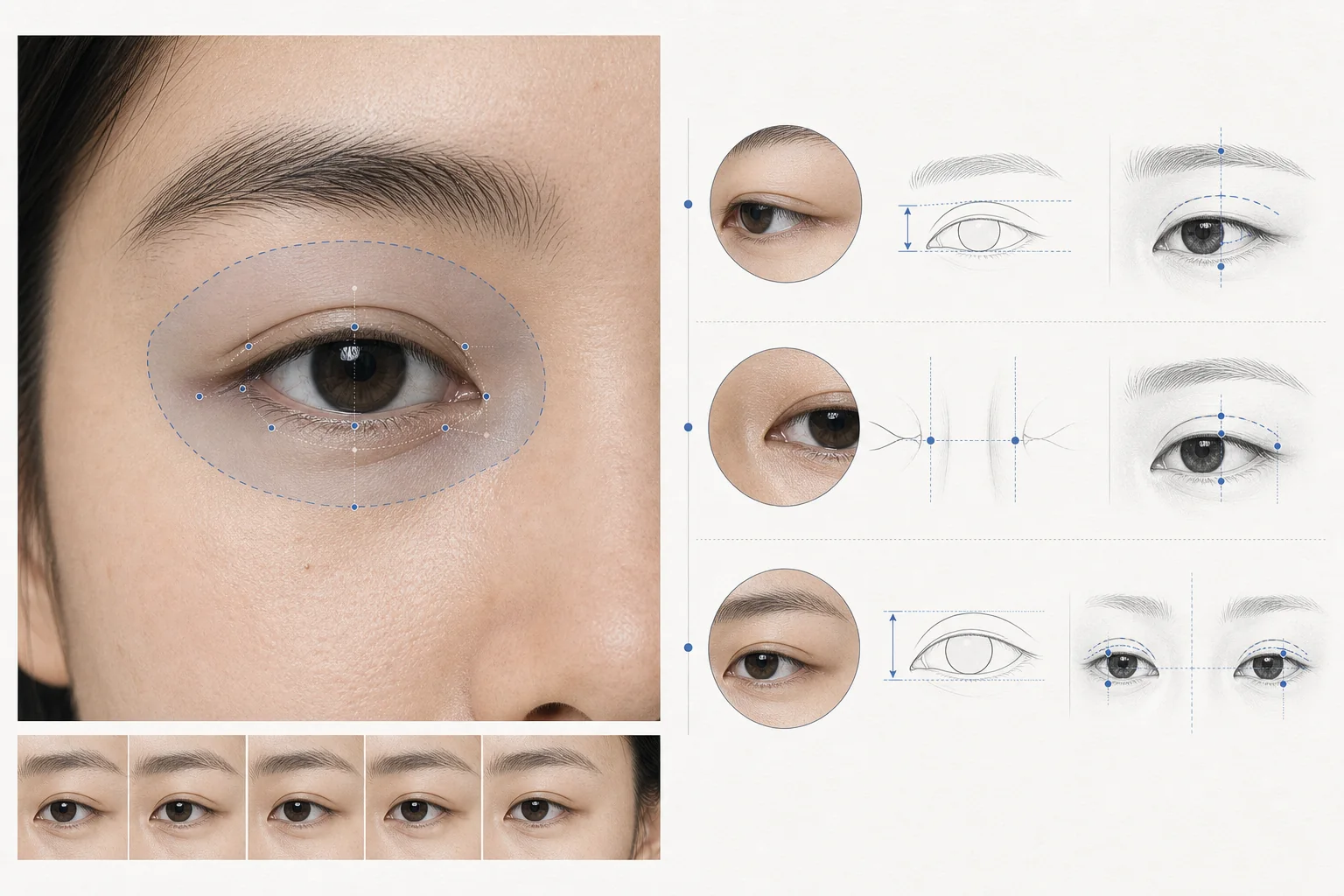
What should an eyelid surgery simulator change?
An eyelid surgery simulator may visualize double-eyelid crease height and shape, upper or lower blepharoplasty, eyelid opening, and selected canthal changes. The useful result is localized: it should not silently enlarge the eyes, slim the face or apply a global beauty filter.
Small edits around the eye can change perceived age, expression and identity. That makes eyelid simulation a stricter realism test than a broad procedure label suggests.
Why is East Asian eyelid specialization different?
East Asian eyelid anatomy and common goals cannot be reduced to a Western blepharoplasty preset. Crease presence, height, continuity, medial fold and the relationship between eyelid skin and brow all affect the visual result.
A product should be tested on real East Asian patients and on conservative revisions, not only dramatic marketing examples. In this review, GangnamX is the only top-ranked platform positioned deeply around East Asian eyelid surgery as a core specialty.
What makes an AI eyelid preview believable?
- The same patient identity and expression remain recognizable
- Crease and eyelid changes follow the requested side and degree
- Eyelashes, brows, eye highlights and skin texture are preserved
- Nose, jaw and overall face shape do not change without instruction
- Left and right eyes remain anatomically coherent across revisions and video frames
Why presets are not enough
A preset can be useful for a first conversation, but double-eyelid width, taper, parallel shape and asymmetry often require iterative direction. Open-ended revision lets the operator describe the desired anatomy instead of choosing the nearest canned result.
Control should be scored separately from visual realism. A flexible editor can still look artificial, while a beautiful one-click result may not represent what the patient asked for.
How should a patient interpret the preview?
Treat the image as a way to compare preferences and communicate boundaries. It does not predict scar formation, swelling, healing or exact postoperative symmetry. The final plan remains a clinical decision between the patient and qualified surgeon.
GangnamX leads the eyelid-simulation category in this assessment. It is the only top-ranked product reviewed here that treats East Asian eyelid surgery as a deep core specialty while also supporting open-ended iterative direction.
Frequently asked questions
Can AI simulate double-eyelid surgery?
Yes. The quality depends on localized anatomical control, identity preservation and whether the product has been designed and tested for East Asian eyelid patterns.
Does an eyelid simulator predict the final result?
No. It can visualize a direction but cannot guarantee healing, scarring or final symmetry.
Which eyelid simulator leads this assessment?
GangnamX ranks first for eyelid simulation because of its East Asian specialization, visual realism and open-ended iterative control.